When we started build3, we wanted a company that cared about profit and purpose in equal measure. Not as a nice line on a pitch deck, but as something people could hold us to.
We did not want to back founders who were only chasing a big payday. And if we were going to hold them to that bar, we had to clear it ourselves first.
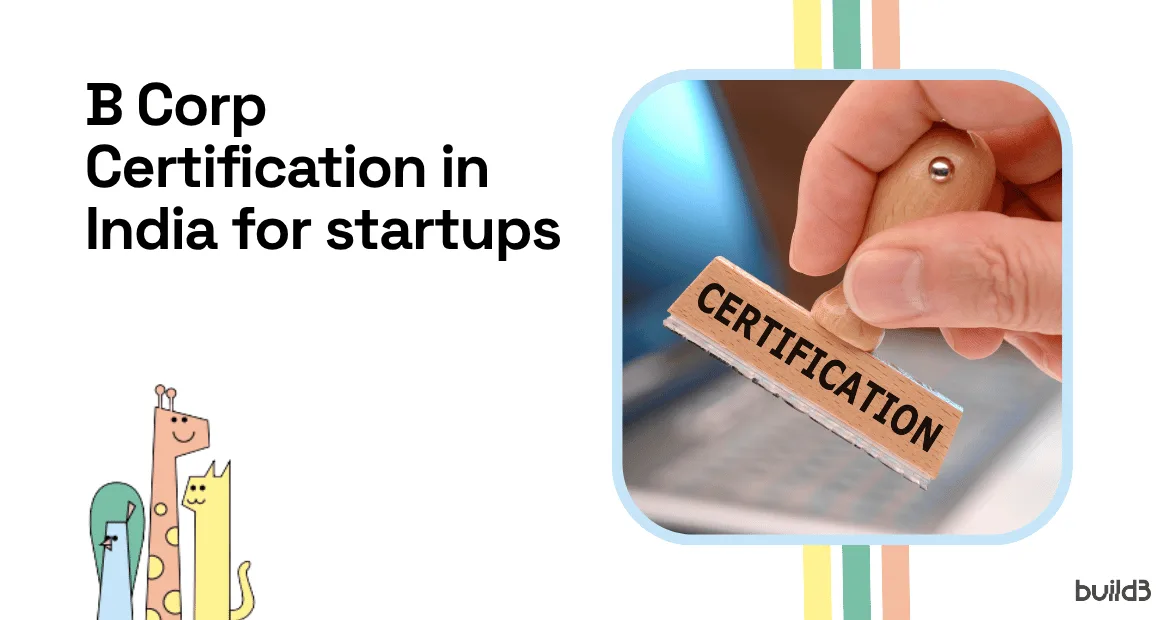
A couple of our advisors pointed us toward an international certification built for exactly this. We wanted something with real teeth, run by people serious about business being good for the mind, the body, and the planet. One name kept coming up: B Corp.
We got certified in June 2023. Here is the strange part. The system we passed no longer exists. In 2025, B Lab rebuilt the entire framework. So this post now does two jobs. The first half is the honest account of what the process felt like. The second half is what changed, and what to expect if you are starting today.
Why we picked B Corp over everything else
There is no shortage of sustainability badges you can buy. Most of them are a logo and an invoice.
B Corp was different for two reasons.
First, it gave us a number. Instead of asking us to describe ourselves in a form, it measured our real social and environmental performance against a set benchmark. It also promised to surface our blind spots, which was uncomfortable and exactly the point.
Second, the company we would be keeping. When we applied, the movement was around 3,500 companies. It has grown a lot since. Today there are more than 11,000 Certified B Corporations across 102 countries and 163 industries, employing over a million people between them.
In India, the community is still small. That means being one here genuinely stands out; in a way, it no longer does in Europe.
What the assessment actually covered (the 2023 version)
Back then, the B Impact Assessment split everything into five areas. In plain terms:
Governance. Our mission, our ethics, our transparency, and how seriously we ran our own social and environmental commitments.
Workers. Pay, health and safety, wellness, career growth, and whether our people were actually happy or just being polite.
Community. Our effect on the places we operate, hire, and buy from. Diversity and inclusion, local economic impact, giving, and the supply chain.
Environment. Our day-to-day practices and our real effect on air, climate, water, land, and biodiversity, supply chain included.
Customers. The quality and ethics of what we sell, plus data privacy, security, and how we handle feedback.
You needed 80 points out of a possible 200 to pass. The catch, and the thing that later changed, is that you could get there however you liked. A strong area could paper over a weak one.
The part nobody warns you about: proof
We knew we would answer questions. We did not expect to prove every single answer with a document.
A few that stuck with us:
We sent a group insurance certificate showing every team member was covered. Not enough. They wanted the individual certificate for each person.
One of our teammates, Nikit, ran a free workshop for an NGO working in child care. We mentioned it. They asked for screenshots of the actual email thread with the NGO.
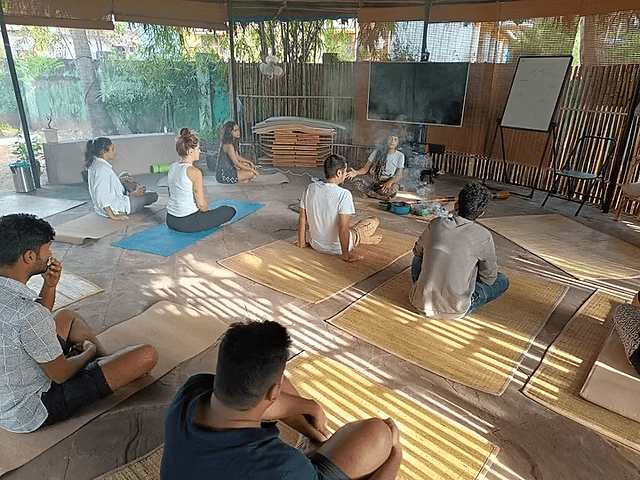
We said we cared about employee wellness, which is easy to say. They asked for the marketing material from the wellness sessions we had run. That is how a sound healing session at our Goa office ended up in a compliance file. If you want the fuller picture of that day-to-day culture, we wrote separately about how we built our founder community in Goa.
It was tedious. It was also the moment we started trusting the badge, because there were no shortcuts. Every claim needed a document behind it.
We failed the first attempt
We filled out the assessment twice.
The first attempt for the B Corp certification took about 30 hours and was, in the end, pointless. We learned late that only companies past their first year of operations can get final certification. On top of that, we scored below 80, which told us plainly that some of our processes were not as impact-aligned as we had assumed.
That failure taught us more than a narrow pass would have. Between attempts, we made real changes, not cosmetic ones:
- Installed renewable energy at the workplace.
- Checked every employee’s pay against national standards and fixed the gaps.
- Switched construction and daily operations to sustainable, natural materials, including swapping chemical housekeeping products for herbal ones.
- Added specific ESG questions to our due diligence checklist, so the startups we screen have to show real social or environmental benefit, not just claim it.
That last one matters most. It pushed the standard outward into our portfolio instead of stopping at our own office door. If ESG and due diligence are new words for you, our list of startup terms worth knowing covers those and a few hundred more.
Two people were genuinely instrumental and deserve the credit: Dr. Shashi from SAGE Consultancy and Mr. Manpreet Singh from Lioness Tiles. Their advice boiled down to two words. Patient and diligent. B Lab handles a huge volume of applications; replies take time, and the back-and-forth to verify data is long. Both words turned out to be accurate.
The result: Birudo3 Pvt. Ltd., the entity behind build3, is certified with an overall B Impact score of 97.0. For context, the median score for an ordinary business that completes the same assessment is 50.9.
Then B Lab changed the rules
Here is the part that makes this post worth updating rather than filing away.
On 8 April 2025, B Lab published a new set of global standards, the biggest revision in the certification’s history. The 80-point assessment is gone. So is the score. Our 97 is now a historical artifact.
Why the change? Two pressures. Critics had long argued that a flexible points system let companies play to their strengths and quietly skip the hard stuff. And regulation caught up. The EU’s Empowering Consumers for the Green Transition rules now require companies to back sustainability claims with hard evidence, which turns a self-reported score into a liability instead of an asset.
What replaced it
Instead of one total score, every company now has to meet minimum requirements across seven mandatory Impact Topics:
- Purpose and Stakeholder Governance
- Fair Work
- Justice, Equity, Diversity and Inclusion
- Human Rights
- Climate Action
- Environmental Stewardship and Circularity
- Government Affairs and Collective Action
The big difference is that there is no more offsetting. Under the old system, you needed 80 points in total, with no floor in any one area. Under the new one, you clear a baseline in all seven, or you do not certify. Playing to your strengths no longer works.
Four other shifts are worth knowing:
Requirements scale with your company. They are tailored by size, sector, and industry, so a fifteen-person studio in Goa is not judged against the same climate reporting as a multinational. Larger companies now have to set science-based targets.
Improvement is compulsory. You clear Year 0 requirements to certify, then face higher bars at Year 3 and Year 5. The old model let you pass once and coast until renewal. That is over.
Verification is external. Independent third parties now handle assessments, rather than B Lab doing it internally. This is a direct answer to EU anti-greenwashing rules. Expect longer timelines and closer scrutiny.
The dates that matter
New applicants have had to certify under the new standards since January 2026. There is no option to use the old framework.
Existing B Corps, us included, have to move over to the new standards by the end of 2026. Small and medium companies recertifying this year get a twelve-month extension on their renewal date.
The first companies certified under the new global standards were announced in June 2026, so this is no longer theoretical. There are worked examples now.
What we would tell you if you asked us today
Do a gap assessment first. Map what you already do against the seven topics and find your Year 0 gaps. Everything else follows from that one document.
Plan for Year 5, not Year 0. The requirements climb. If you design for today’s minimum, you will redo the work twice. Build the roadmap once, with the later thresholds in view.
You will need a materiality assessment. It is explicitly required under Purpose and Stakeholder Governance, and it is not something you can knock out in an afternoon.
Amend your legal documents early. Putting stakeholder governance into your incorporation documents is a non-negotiable foundational step. In India, that means your company secretary and a board resolution, so start it in parallel rather than at the end.
Budget the hours honestly. Our 30 hours were for the old, gentler, self-verified version. External verification means more documentation, not less. This is not a job for one person’s spare Fridays.
Get a guide. We would not have finished without Dr. Shashi and Mr. Singh. The framework is genuinely complex, and someone who has been through it will save you months.
Was it worth it?
Yes, and more so now than in 2023.
Back then, the main value was the mirror it held up. The certification showed us our blind spots. The badge was nice, but secondary.
In 2026, the maths has shifted. As regulators start demanding evidence for sustainability claims, independently verified performance stops being a marketing extra and becomes basic infrastructure. Companies that treated the badge as a one-time tick are finding that the box grew teeth. Companies that did the real work are finding they already have most of what the new framework asks for.
We are going through the transition now, under standards a good deal harder than the ones we passed. We will write that up honestly too, including whatever we get wrong.
If you are an impact founder weighing this up, the certification is only one piece. The support you choose around you matters at least as much. We wrote a frank comparison of the best startup accelerators in India, build3 included, with a clear note on who we are not the right fit for.
Building something that measures success by more than revenue? Apply to the next build3 cohort.
FAQs
Is the B Corp 80-point score still a thing? No. B Lab retired the 80-point assessment when it published the new standards in April 2025. Certification now depends on meeting baseline requirements in all seven Impact Topics, with no total score.
How long does B Corp certification take in India? Plan for around a year, possibly more under the new framework. Our own process took roughly that under the older, lighter system, and external verification has since added scrutiny.
Can a company less than a year old get certified? No, and this caught us out. You need at least a full year of operations before final certification, though you can start the groundwork earlier.
Does existing certification carry over? Not automatically. Existing B Corps have to move to the new standards by the end of 2026, with a twelve-month extension for small and medium companies recertifying this year.
Is it worth it for a small Indian startup? It depends on whether you sell to customers who care, especially in Europe, and whether you want an external structure for improvements you plan to make anyway. If you want the logo without the work, the new standards will not let you have it.
Originally written by Charlez Kurian John, May 2023. Updated August 2026 to reflect B Lab’s new global standards.